NO FEED · AI-assisted development
What leaves your repository when you use an AI coding assistant?
Compare specific Claude Code, Cursor and Copilot data paths: code transmission, indexing, training, retention, cloud sessions and feedback exceptions.
Cursor's current Search documentation says Instant Grep builds and queries its index on the machine; it does not upload code or paths to build that search index or store codebase embeddings for search. When the agent opens a match, however, that file content can enter a model request. [1]
Code can leave your machine without being used for training or kept as a permanent repository copy. Review transmission, storage, training and deletion separately, for the exact product surface, account and model you use. A local editor describes where you work; it does not describe every place your request is processed.
Take a hypothetical private payments repository. A developer asks why a refund test fails, attaches the error, and lets an assistant inspect the relevant function. The approval question is not simply whether the repository is private. It is which code, logs and identifiers enter that request, which services receive them, and what survives afterward.
The examples below cover selected Claude Code, Cursor and GitHub Copilot modes, using official documentation read on 19 October 2026. They are a comparison of specific data paths, not an exhaustive vendor privacy ranking or a compliance determination.
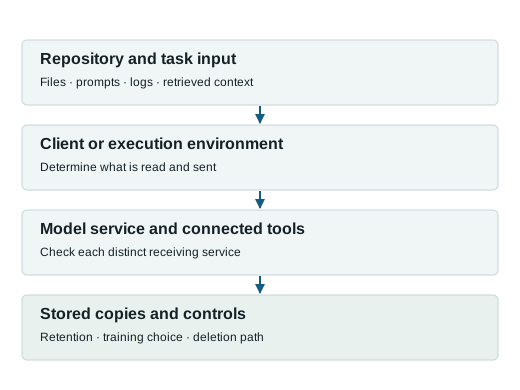
Five questions that “no training” does not answer
For the payments example, create a small record before choosing a product setting:
| Question | Record for this task | Why it changes the decision |
|---|---|---|
| What is transmitted? | Prompt, selected code, retrieved context and test output | A failing log may contain more sensitive data than the function |
| Who receives it? | Assistant operator, model provider, connected services | A model selection does not identify every processor |
| What is retained? | Requests, session history, repository copies, indexes and local logs | Each object can have a different lifetime |
| What may be reused? | Training setting, feedback choice and organization policy | Storage and model improvement are separate purposes |
| How is it removed? | Applicable deletion control and exceptions | Closing an editor is not a deletion procedure |
This is NO FEED's proposed review format. It makes missing information explicit. An unknown retention period should remain unknown until the relevant provider or contract answers it.
The confusion predates today's settings. In June 2025, Reddit user UnchartedFr asked how a Cursor privacy-mode email could combine model-provider zero retention with storage for product features. That historical question captures the distinction; it is not evidence of October 2026 policy, an observed leak or a broken promise. [2]
Compare the mode, not just the logo
These are documented defaults and conditions, not observations of your account:
| Product and scope | Training condition | Retention or processing distinction |
|---|---|---|
| Claude Code through consumer Free, Pro or Max | Model improvement depends on the user's setting | Documentation lists 5 years when enabled; 30 days when disabled. [3] |
| Claude Code under commercial terms | No generative-model training by default; explicit contribution programs are exceptions | Standard Team, Enterprise and API retention is listed as 30 days. Qualified Enterprise ZDR requires separate enablement. [3] |
| Cursor with Privacy Mode | Customer data is not used for training by Cursor | Provider ZDR arrangements have abuse-review and designated non-ZDR-model exceptions; requests still pass through Cursor's backend. [4] |
| Copilot Business/Enterprise: IDE chat and completions | Business protections apply | GitHub's FAQ says prompts/suggestions are not retained for this surface; engagement and feedback have separate policies. [5] |
| Copilot Business/Enterprise: other access and use | Business protections apply | The same FAQ gives 28 days for prompts/suggestions; provider/model exceptions require another check. [5] |
The Copilot rows are GitHub's service-level FAQ defaults. They must be read alongside its model-hosting documentation: Claude Fable 5 and 5.1 involve provider retention by default, with qualified, configured enterprise exemptions described through the end of 2026. Other preview-feature exceptions also exist. A broad retention sentence is not a substitute for checking the selected model and feature. [6]
Individual Copilot subscriptions have another distinction. GitHub's March 2026 announcement describes model-training use of interaction data subject to user settings and an opt-out. It distinguishes data generated during a session, which can involve a private repository, from training on that repository's stored contents at rest. Business and Enterprise users were not affected by that update. [7]
For our developer, “private repo” and “paid subscription” therefore leave important questions unanswered. The actual account, organization policy and feature belong in the approval record.
A local search index and a model request are different paths
That changes the payments example. Finding the refund function locally does not mean the subsequent explanation is computed locally. Conversely, a remote model request does not establish that the entire repository was uploaded for an index. Describe each operation accurately instead of assigning one location to the whole product.
Cursor also says bringing your own API key does not bypass its backend, where it performs final prompt construction. Its data-use page describes temporary encrypted file-content caching and notes that, with Privacy Mode enabled, those cached contents are not used for training. These are separate from a promise that no content ever reaches a server. [4]
Cloud work introduces another object. Cursor's enterprise governance documentation describes temporary encrypted repository copies for Cloud Agents and says those copies are deleted after the agent completes. A policy that permits a request containing selected code but prohibits a hosted working copy needs to distinguish those features. [8]
Session history and feedback need their own rows
Claude Code's data-usage page says local clients keep plaintext transcripts under ~/.claude/projects/, normally for 30 days, with a configurable cleanup period and exceptions for sessions continued in Desktop or Cowork. It separately describes transcripts submitted through /feedback, /bug or /share as retained for five years. Those feedback submissions should not inherit an inference-retention assumption. [3]
Enterprise ZDR is also scoped. Anthropic says it covers eligible Claude Code inference on its direct platform, requires per-organization enablement and does not extend to third-party tools or MCP servers. The documentation retains legal and misuse exceptions. A personal login or a different organization does not automatically receive the approved organization's treatment. [9]
For our payments investigation, a copied error log could consequently appear in a model request, a local transcript and a later support submission. Review each transfer deliberately. Use synthetic customer identifiers when reproducing the failure; if real records are necessary, obtain the appropriate project decision before adding them to the task.
Make one real workflow explainable
Our proposed final check follows one non-sensitive sample from the actual account and product surface. Record the model, privacy setting, enabled integrations and whether execution is local or cloud. Observe which files the agent reads and what tools it calls. Compare available client or organization logs with the documented data paths; avoid collecting real secrets merely to test logging.
Network observations can show a destination was contacted. They do not prove a provider's retention or training behavior. For those claims, keep the dated official policy and applicable contractual answer with the record. Likewise, an absence of obvious traffic in a short sample is not proof that every feature is local.
Before granting access to the payments repository, finish one sentence precisely: “This account may send these inputs through these services, with these storage and reuse conditions.” If a newly enabled model, cloud agent or connector makes that sentence false, review that new path before using it with the repository.
Sources & context
- Cursor — Search, current Instant Grep documentation, read 19 October 2026. Older remote-index descriptions are not used as current evidence.
- UnchartedFr — New privacy mode?, 20 June 2025. Historical user question; original and returned reply checked on 19 October 2026, not evidence of current policy.
- Anthropic — Claude Code data usage, current documentation, read 19 October 2026.
- Cursor — Data Use & Privacy Overview, updated 3 September 2026, read 19 October 2026.
- GitHub — Copilot FAQ, Business/Enterprise retention sections, read 19 October 2026.
- GitHub — Hosting of models for GitHub Copilot, current model-specific conditions, read 19 October 2026.
- GitHub — Updates to our Privacy Statement and Terms of Service, 25 March 2026, read 19 October 2026.
- Cursor — Privacy and Data Governance, current Cloud Agent and model-policy documentation, read 19 October 2026.
- Anthropic — Claude Code zero data retention, current eligibility, scope and exception documentation, read 19 October 2026.